
Crypto⏱️ 7 min readFor crypto affiliates and media buyers
Crypto CPA offers pay you a fixed amount when a user you referred completes a qualifying action, such as signing up, verifying their account and making a first deposit. Many crypto affiliate programs also offer RevShare, a share of the fees your users generate over time, or a hybrid of the two. If you buy traffic to promote these offers, the payout model decides how you measure success, how fast you get your money back and how you should bid.
This guide explains the main crypto payout models, what usually counts as a qualified user, how to track every step with S2S postbacks and how to optimize paid campaigns toward the event that pays. It’s about affiliate marketing and media buying, not investing.
🔑 Key takeaways
- CPA pays once per qualified user. It’s the easiest model for paid traffic because you know what a conversion is worth.
- RevShare pays a share of the fees your users generate for as long as they trade. It can pay more over time but returns your ad spend slowly.
- Hybrid deals combine a smaller CPA with a smaller RevShare.
- Know the qualification event, track it with S2S postbacks and optimize to cost per qualified user, not cost per click.
How Crypto Affiliate Payouts Work
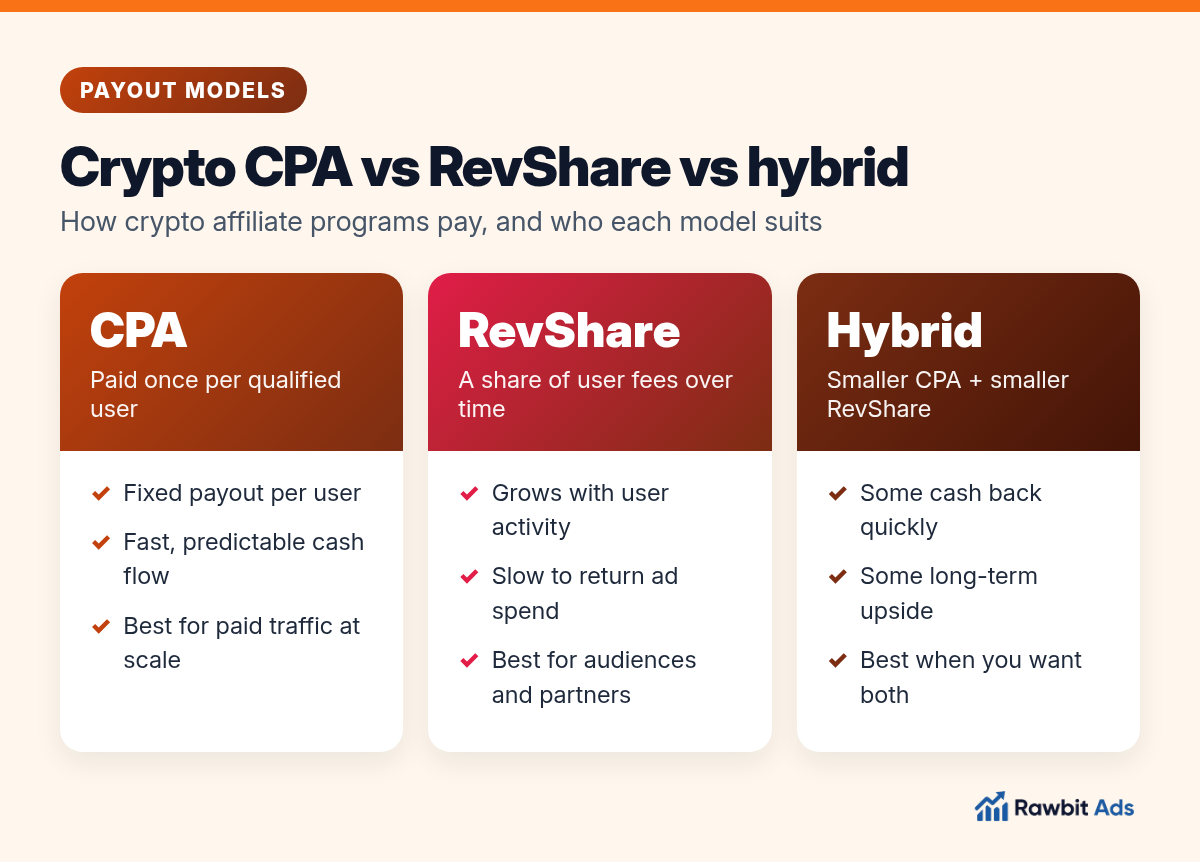
CPA (cost per acquisition)
You earn a fixed payout each time a referred user completes the qualifying action. Bitget’s academy explains crypto affiliate commissions this way, describing the action as typically registration, verification and a first deposit. CPA suits paid traffic because you can compare your cost per conversion to a known payout every day.
RevShare (revenue share)
You earn a percentage of the fees or revenue your referred users generate, often for as long as they stay active. Track360’s guide to crypto commission models notes that RevShare rewards user quality but pays slowly, which makes it harder for media buyers who need to recover ad spend quickly. Earnings also move with trading activity, so a quiet month means a smaller payout.
Hybrid
A hybrid deal pays a smaller fixed amount per qualified user plus a smaller revenue share. It gives you some cash back quickly and some long-term upside.
| Model | You’re paid for | Cash flow | Best for |
|---|---|---|---|
| CPA | Each qualified user | Fast and predictable | Paid traffic at scale |
| RevShare | A share of user fees over time | Slow, grows with retention | Audiences and long-term partners |
| Hybrid | Both, at lower rates | Mixed | Buyers who want some of each |
If you’ve worked with iGaming, this will look familiar. Our iGaming CPA offers guide covers the same three models for casino and betting.
Know the Qualification Event
Before you buy a single click, find out exactly what counts as a conversion. Ask the affiliate program or network:
- Which event triggers the payout? Registration, verification, first deposit, a minimum deposit, a first trade or a minimum trading volume.
- Is there a minimum amount? Some offers only count deposits or trades above a threshold.
- Is there a holding period? Some programs confirm conversions only after a set time.
- Which events can they postback? Ideally registration, verification and deposit, so you can optimize on early signals too.
This matters because your break-even bid depends on it. If only one in several registrations becomes a qualified user, a “cheap” registration may still lose money.
Tracking Crypto Offers With S2S Postbacks
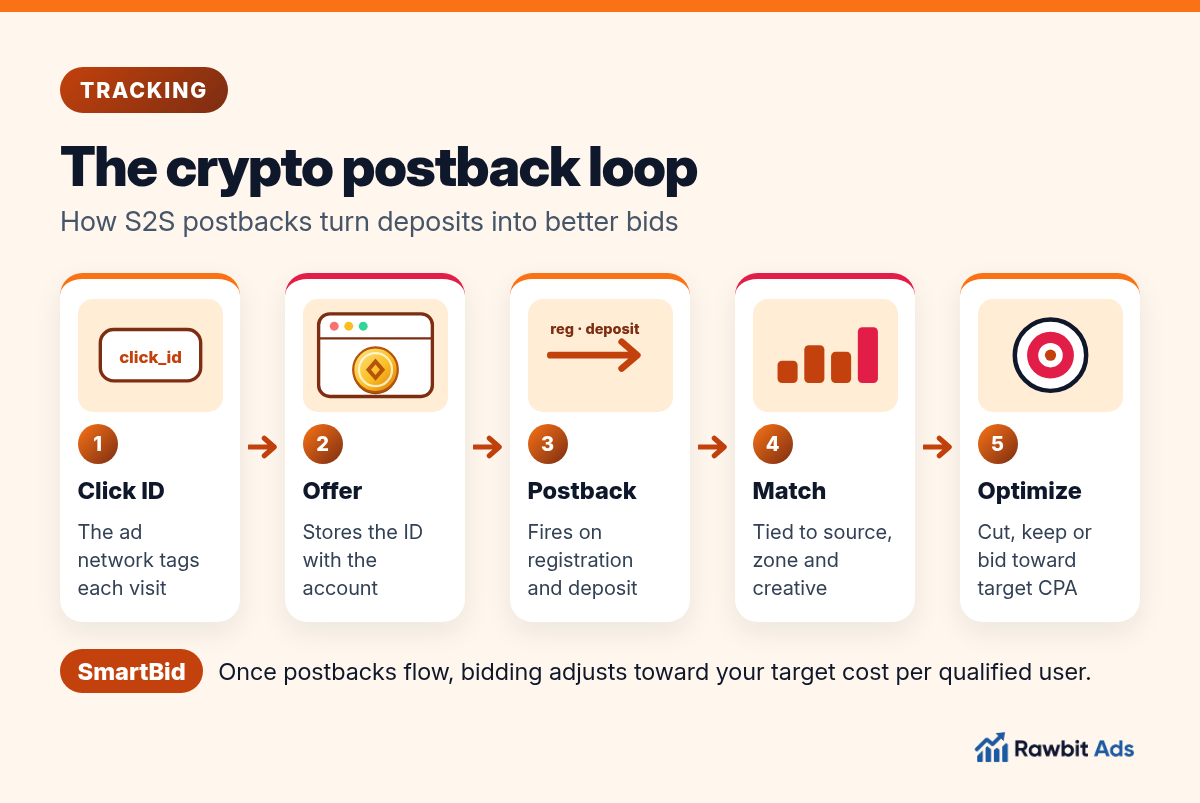
Server-to-server (S2S) postback tracking is the standard way to connect conversions back to the ad that caused them. It doesn’t rely on browser cookies, which makes it more reliable for funnels that run over hours or days.
Pass the click ID.
Add the ad network’s click ID macro to your offer or tracker link so every visit carries a unique ID.
Store it at the offer.
The affiliate program or your tracker keeps the click ID with the user’s account.
Fire a postback for each event.
When the user registers, verifies or deposits, the offer calls the ad network’s postback URL with the click ID and event name.
Match and report.
The ad network ties the conversion to the source, zone, creative and campaign.
Optimize.
You, or automated bidding, use that data to cut weak sources and bid more on strong ones.
💡 Pro tip
Send the early events too, not just the deposit. Registrations arrive sooner and in larger numbers, so they help you spot weak sources days before deposit data is clear. Just make sure the final decisions use the event you’re actually paid on.
Working Out Your Break-Even Bid
A simple way to sanity-check your numbers:
- Break-even cost per qualified user = your CPA payout.
- Break-even cost per registration = payout × the share of registrations that qualify.
- Break-even CPC = break-even cost per registration × your click-to-registration rate.
Use your own data from a test campaign for each rate. Our CPC vs CPM vs CPA guide explains how to convert between pricing models.
Track your crypto offers with Rawbitads →
Optimizing Crypto Campaigns Toward Deposits
Sources
- Set a spend threshold for each source, such as twice your target cost per registration. Blacklist sources that pass it without converting.
- Look past registrations. A source with many sign-ups and no deposits is expensive. Judge it on cost per qualified user.
- Whitelist proven sources and run them in their own campaign with a higher bid.
Creatives and pages
- Test hooks on push and in-page push, and pre-landers on pop. Our crypto ad creatives guide covers angles and pre-lander types.
- Refresh creatives before they tire, and keep the same promise from ad to offer page.
Bids and automation
- Start on CPC or CPM to learn, then move to bidding toward a target CPA once conversions flow. Google describes target CPA bidding as setting bids to get as many conversions as possible at or below the cost per action you set, and the same idea applies on ad networks.
- On Rawbitads, SmartBid adjusts bids and blacklists weak zones in real time toward your target cost per conversion.
The same weekly routine works well across verticals. Our iGaming campaign optimization guide walks through it step by step.
A Weekly Optimization Routine
- Monday: review sources against your thresholds, then update blacklists and whitelists.
- Midweek: check creatives for falling CTR and add new hooks.
- Friday: compare pre-landers and adjust bids on proven sources.
- Every week: check that postbacks match the affiliate program’s own stats, so you’re optimizing on correct data.
Common Tracking Mistakes to Avoid
- Missing the click ID. If the macro isn’t in the link, conversions arrive without a source and can’t be used for optimization.
- Only tracking deposits. Deposit data comes slowly. Send registrations too, so you can spot weak sources sooner.
- Mixing events. Name each postback event clearly, so a registration is never counted as a deposit.
- Not testing end to end. Always run a test conversion through the whole chain before you spend.
- Ignoring discrepancies. Compare your ad network stats with the affiliate program’s dashboard every week. A gap usually means a broken parameter or a missed event.
- Optimizing on rejected conversions. If the program later rejects users who didn’t qualify, make sure your decisions use confirmed numbers.
Frequently Asked Questions
What are crypto CPA offers?
Crypto CPA offers pay affiliates a fixed amount for each referred user who completes a qualifying action, such as registering, verifying their account and making a first deposit or trade.
Is CPA or RevShare better for crypto?
CPA is usually easier for paid traffic because the payout is fixed and paid sooner, so you can measure profit quickly. RevShare can pay more over time if users stay active, but it returns your ad spend slowly. Hybrid deals offer some of each.
What counts as a qualified user in crypto affiliate programs?
It depends on the program. Common qualification events are registration plus verification plus a first deposit, sometimes with a minimum deposit or trading volume. Always confirm the exact event before you buy traffic.
How do I track crypto affiliate conversions?
Use S2S postback tracking. Pass the ad network’s click ID to the offer, and have the offer send a postback with that ID for each event, such as registration and deposit. The network then ties each conversion to its source.
How do I optimize crypto campaigns?
Set spend thresholds to cut weak sources, judge sources on cost per qualified user, whitelist proven ones, test hooks and pre-landers, and move to target-CPA bidding, such as SmartBid on Rawbitads, once conversions flow.
Know Your Payout, Track Every Step
Crypto affiliate offers reward buyers who know exactly what they’re paid for and measure it accurately. Confirm the qualification event, set up postbacks for every step, work out your break-even bids and let cost per qualified user guide where you scale.
📚 Related guides
Optimize your crypto offers toward deposits
Send postbacks to Rawbitads and let SmartBid bid toward your target cost per qualified user across push, pop, in-page, native, Telegram and direct click.
Start optimizing →