Media Buying⏱️ 7 min readFor advertisers and media buyers

CPC vs CPM vs CPA is one of the first decisions you make in any ad network campaign, and one of the easiest to get wrong. The pricing model decides what you pay for: a click, a thousand impressions or a conversion. It also decides who carries the risk, how fast you collect data and how much control you have over cost.
This guide explains how each model works, gives you the simple formulas to compare them on the same scale, and shows when to use each one, including when to hand the bidding over to an automated system.
🔑 Key takeaways
- CPC means you pay per click. It’s predictable and a good default for testing creatives.
- CPM means you pay per thousand impressions. It rewards strong creatives and landing pages and is the natural model for full-page formats like pop.
- CPA means you pay per conversion. It shifts risk to the network but needs reliable conversion tracking.
- Compare models with effective metrics (eCPC, eCPM, eCPA) and your break-even bid, then let smart bidding take over once you have conversion data.
What Do CPC, CPM and CPA Mean?
All three are ways of pricing the same thing, attention that might turn into a sale. They differ in which event triggers the charge.
- CPC (cost per click): you pay each time someone clicks your ad. Google’s definition of actual CPC is “the final amount you’re charged for a click”.
- CPM (cost per mille): you pay for every thousand impressions, whether or not anyone clicks. Google describes CPM as a way to bid where you pay per one thousand views.
- CPA (cost per action): you pay when a defined action happens, such as a registration, a deposit or a sale.
CPC vs CPM vs CPA at a Glance
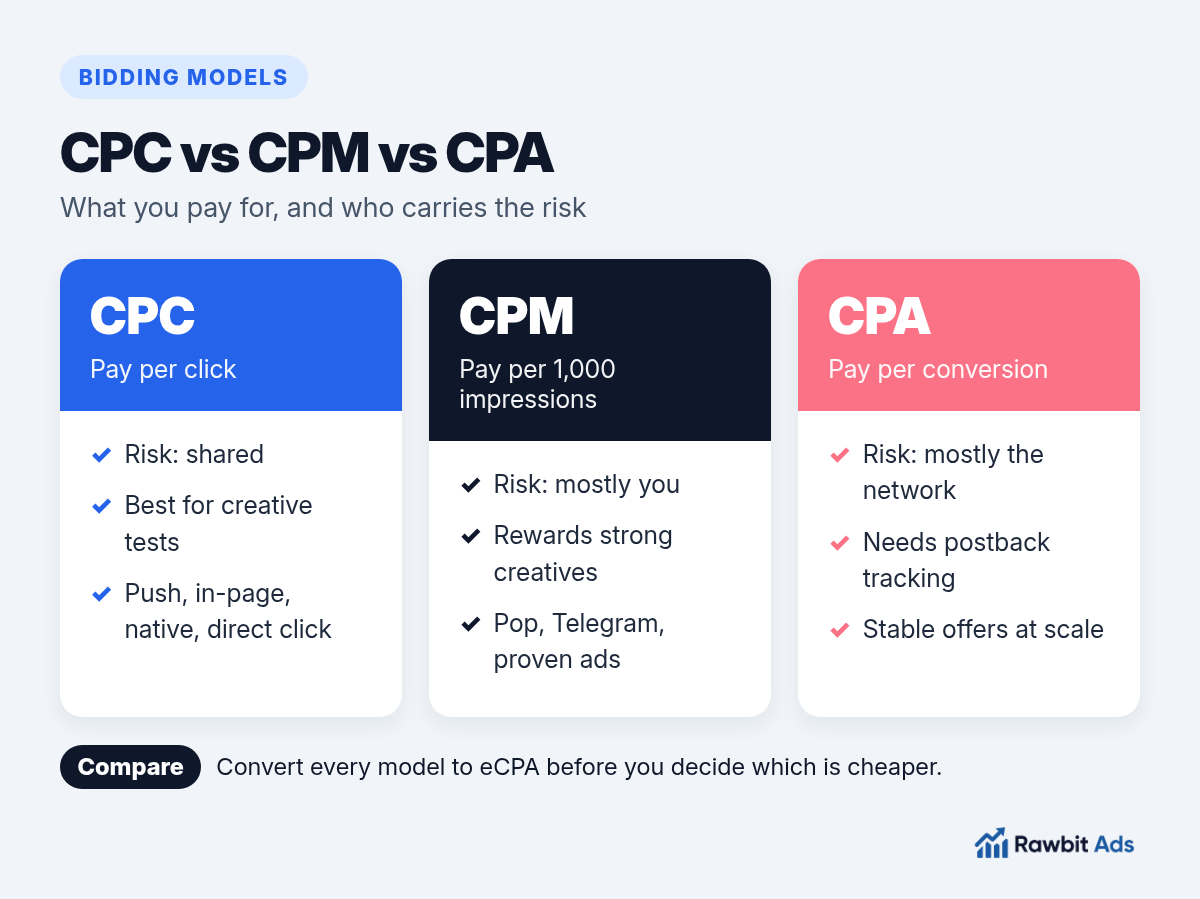
| Model | You pay for | Who carries the risk | Best for | Watch out for |
|---|---|---|---|---|
| CPC | Each click | Shared: you pay for clicks, the network for impressions | Creative tests, push, in-page push, native, direct click | Clicks that never convert |
| CPM | 1,000 impressions | Mostly you | Pop, Telegram, proven creatives at scale | Paying for views that don’t click |
| CPA | Each conversion | Mostly the network | Stable offers with reliable tracking | Needs postbacks and enough volume to learn |
On Rawbitads, each format supports the models that fit it: push, in-page push and native on CPC or CPM, pop on CPM or CPA, direct click on CPC and Telegram on CPM. You can see the full list on the ad formats page.
The Formulas: Comparing Models on the Same Scale
Different campaigns may run on different models, so convert everything into effective costs before you compare them:
- eCPM = spend ÷ impressions × 1,000
- eCPC = spend ÷ clicks
- eCPA = spend ÷ conversions
- CTR = clicks ÷ impressions
- CR (conversion rate) = conversions ÷ clicks
Then work out what you can afford to pay. If you know your payout per conversion and your conversion rate, your break-even bids are:
- Max CPA = payout per conversion
- Max CPC = payout × CR
- Max CPM = payout × CR × CTR × 1,000
Here’s a simple illustration with made-up numbers. Say an offer pays $20 per conversion, your landing page converts 2% of clicks and your creative gets a 1% CTR. Your break-even CPC is $20 × 0.02 = $0.40, and your break-even CPM is $20 × 0.02 × 0.01 × 1,000 = $4.00. Bid below those numbers to leave room for profit.
💡 Pro tip
Recalculate break-even bids for each segment, such as OS, device or language, rather than for the whole campaign. A campaign can be profitable overall while one segment quietly loses money.
When to Use CPC
CPC is the safest place to start for most click-based formats.
- You’re testing creatives. You only pay when someone engages, so a weak creative costs little.
- You don’t yet know your CTR. CPC protects you from paying for impressions on a creative nobody clicks.
- The format is click-driven. Push, in-page push, native and direct click are all built around the click. Our in-page push ads guide shows a CPC test setup.
The trade-off: you still pay for clicks that don’t convert, so a high CTR with a weak landing page can be expensive.
When to Use CPM
CPM rewards you for having a strong creative or landing page, because you pay the same per thousand impressions however many clicks you get.
- The format shows a full page. With pop, the landing page is the ad, so there’s no click to price. See what popunder traffic is.
- You’ve proven your creative. If your CTR is above average for the placement, CPM can bring your effective CPC down.
- You want reach in a specific place. Telegram channel posts are priced on views, which suits CPM. Our Telegram ads guide covers it.
The trade-off: you carry the risk. If CTR or conversion rate drops, your eCPA rises with it.
When to Use CPA
CPA bidding aligns your cost with the result you actually want.
- Your tracking is solid. CPA needs S2S postbacks that report conversions back to the network reliably.
- Your offer converts consistently. The system needs enough conversions to learn which zones and users perform.
- You want to limit risk. You pay per result, so a bad zone costs less.
The trade-off: CPA campaigns can take time to gather volume, and networks need conversion data before they can deliver efficiently. For iGaming offers that pay on first deposits, our iGaming CPA offers guide explains how to track the right event.
From Manual Bids to Smart Bidding
Once conversions are flowing, managing bids zone by zone by hand gets slow. That’s where automated bidding helps.
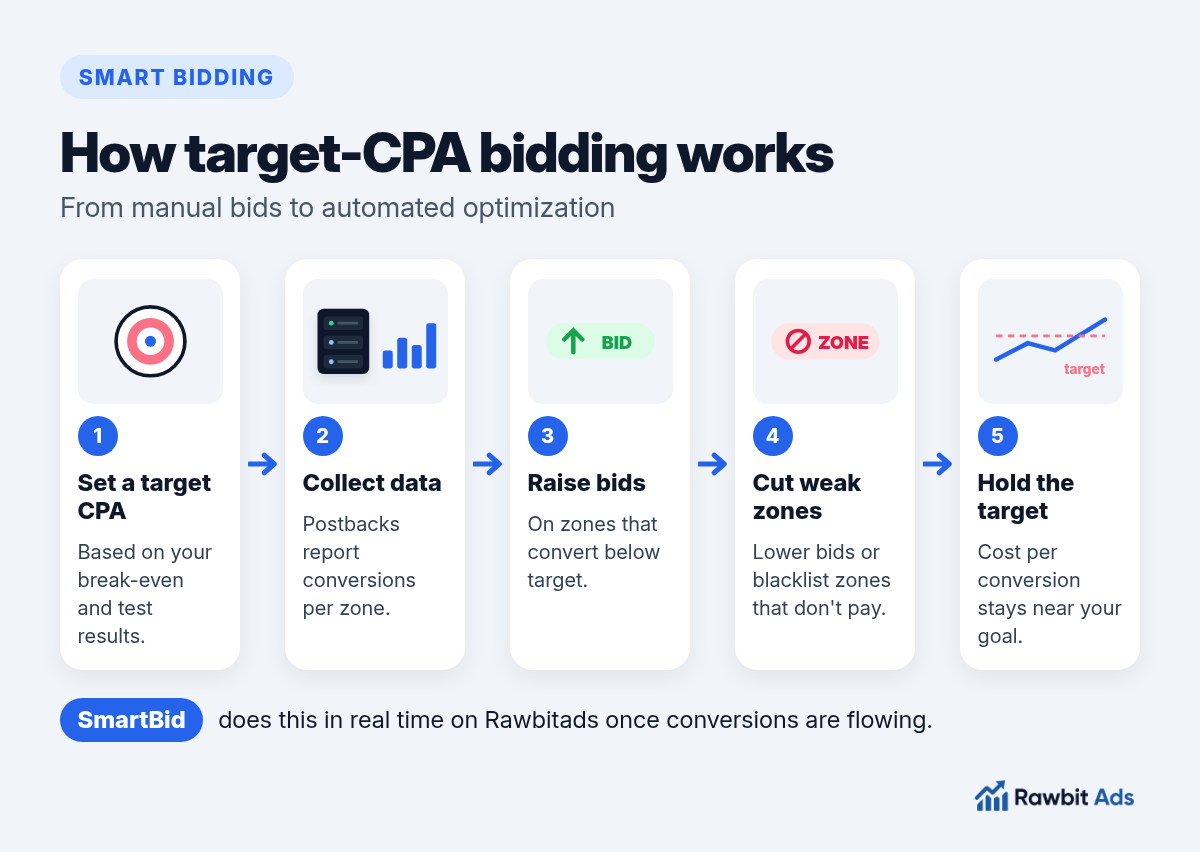
The idea is the same across platforms. Google describes Target CPA bidding as an automated strategy where you set your desired average cost per conversion and the system sets bids based on the likelihood of each impression to convert. Google also recommends measuring results over periods with at least 30 conversions.
On Rawbitads, SmartBid does this job for ad network traffic. It adjusts bids and blacklists weak zones in real time toward your target CPA, so budget moves to the placements that convert.
Start manual.
Launch on CPC or CPM to collect clicks, conversions and zone data.
Set up conversion tracking.
SmartBid and any target-CPA system can only optimize what they can see.
Pick a realistic target.
Base your target CPA on your break-even number and the CPA you actually achieved in testing.
Switch and leave it alone.
Give the system time to learn before you change targets or creatives.
Review by segment.
Check results by OS, device and format, and keep adding fresh creatives.
Common Bidding Mistakes
- Comparing CPC to CPM directly. Always convert to eCPA before deciding which model is “cheaper”.
- Bidding the minimum. The lowest bid often wins only the leftover inventory. Bid close to break-even while you test, then optimize down.
- Changing everything at once. If you change bid, creative and targeting together, you can’t tell what worked.
- Judging too early. A handful of conversions isn’t a trend. Wait for enough data before cutting a zone or a model.
Frequently Asked Questions
What is the difference between CPC, CPM and CPA?
CPC charges you per click, CPM per thousand impressions and CPA per conversion, such as a sale or registration. They differ in what triggers the charge and in who carries the risk if the traffic doesn’t convert.
Which is better, CPC or CPM?
Neither is better in general. CPC is safer for testing new creatives because you only pay for engagement. CPM can be cheaper once you have a proven creative with a strong CTR, and it suits full-page formats like pop.
How do I calculate eCPM?
Divide your total spend by your impressions and multiply by 1,000. For example, $50 spent on 25,000 impressions gives an eCPM of $2.00.
When should I switch to CPA bidding?
Switch once your conversion tracking is reliable and your campaign has collected enough conversions for the system to learn. Base your target on your break-even CPA and the results you achieved in testing.
What is SmartBid?
SmartBid is Rawbitads’ automated bidding. You set a target CPA, and it adjusts bids and blacklists weak zones in real time to keep your cost per conversion close to that target.
Choose Your Model, Then Let the Data Decide
Start on CPC for creative tests, use CPM where the format or a proven creative makes impressions valuable, and move to CPA or smart bidding once tracking and volume are in place. Whatever you choose, compare everything on effective cost per conversion.
📚 Related guides
Bid smarter on Rawbitads
CPC, CPM and CPA bidding across push, pop, native, Telegram and more, with SmartBid adjusting bids and blacklisting weak zones toward your target CPA.
Create a campaign →