
iGaming⏱️ 7 min readFor iGaming affiliates and media buyers

iGaming CPA offers pay you a fixed amount when a referred player completes a defined action, usually a first deposit. For media buyers that’s a big advantage: you know what a conversion is worth before you spend anything, so you can set bids, cut losers and scale winners with simple maths. But the details of each offer, and how well you track them, decide whether that maths works.
This guide explains how CPA offers work in iGaming, how they compare with RevShare and hybrid deals, what an FTD is, and how to set up S2S postback tracking so your ad network optimizes toward real deposits.
🔑 Key takeaways
- An iGaming CPA offer pays a fixed amount per qualifying action, most often a first-time deposit (FTD) that meets a minimum.
- CPA gives predictable payouts for paid traffic, RevShare pays a share of player revenue over time, and hybrid mixes both.
- Your maximum CPA bid comes from the payout and your expected registration-to-deposit rate.
- S2S postback tracking with a click ID ties each deposit back to the zone and creative that produced it.
What Are iGaming CPA Offers?
In iGaming affiliate programs, CPA (cost per acquisition) means the operator pays you a set fee for each new player who meets the offer’s conditions. Those conditions are the most important part of the deal. Typically they define:
- The conversion event. Usually a first deposit, sometimes a registration or a deposit above a set amount.
- The baseline. A minimum deposit, wagering or activity level a player must reach before the CPA is paid.
- Accepted traffic sources and GEOs. Which ad formats and countries the offer accepts.
- Caps and hold periods. Daily or monthly limits, and how long conversions are reviewed before payout.
The same structure applies to casino CPA offers and sports betting CPA offers. Read these terms before you launch. Two offers with the same headline payout can be worth very different amounts once you factor in the baseline and the traffic types they accept.
What does FTD mean in iGaming?
FTD stands for first-time deposit: the first time a newly registered player puts money into their account. It’s the most common CPA trigger because it separates players who are actually playing from those who only signed up. For media buyers, cost per FTD is usually the metric that decides whether a campaign lives or dies.
CPA vs RevShare vs Hybrid
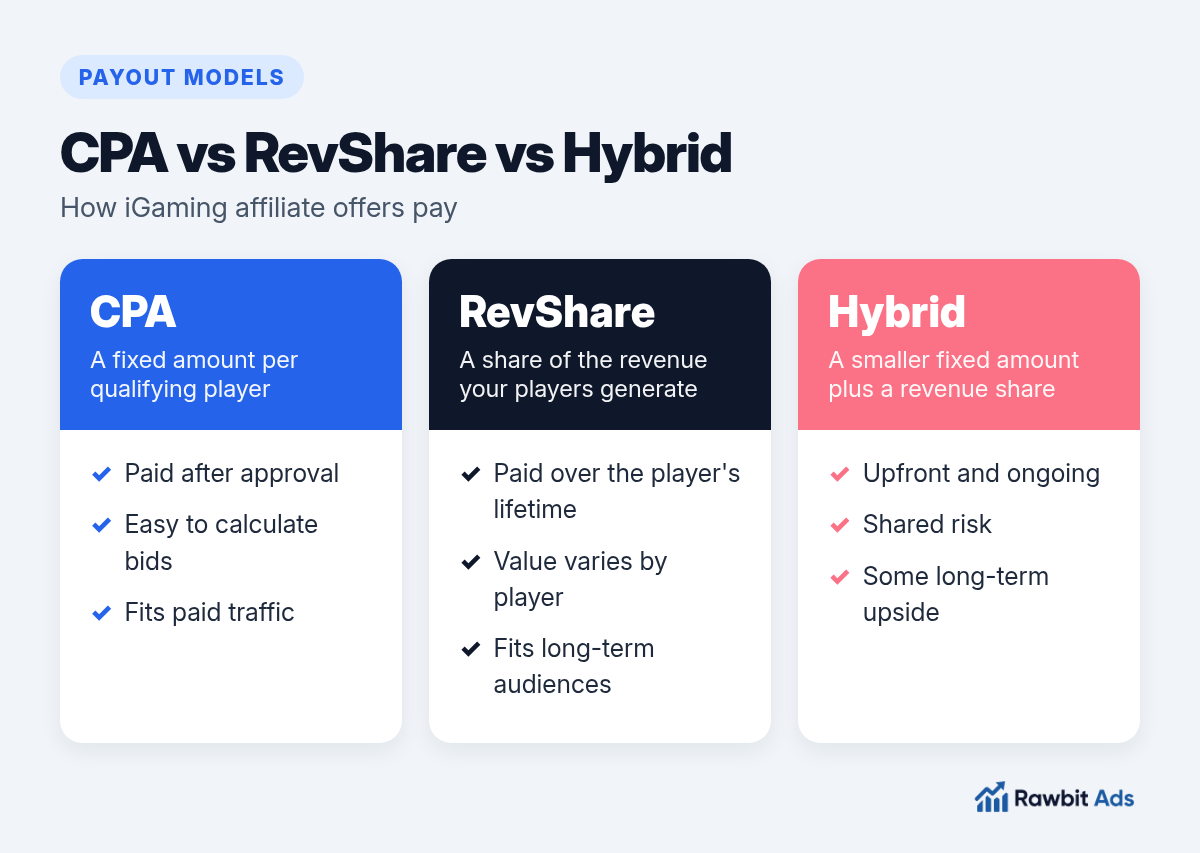
| CPA | RevShare | Hybrid | |
|---|---|---|---|
| How you’re paid | A fixed amount per qualifying player | A percentage of the revenue your players generate | A smaller fixed amount plus a revenue share |
| When you’re paid | After the conversion is approved | Over the player’s lifetime with the operator | Both: upfront and ongoing |
| Cash-flow fit for paid traffic | Strong: recover spend quickly | Weaker: spend now, earn later | Balanced |
| Risk | Offer terms and baselines | Player value can vary a lot | Shared |
| Best for | Media buyers buying traffic at scale | Affiliates with long-term audiences | Buyers who want some upside |
RevShare deals are usually based on the operator’s revenue from your players, often described as GGR or NGR. PropellerAds’ guide to iGaming metrics explains these terms in more detail.
How to Pick an iGaming CPA Offer for Paid Traffic
Whether you find offers through an iGaming CPA network or directly through an operator’s affiliate program, use this checklist before you commit budget:
- Does it accept your format? Confirm that push, pop, in-page or native traffic is allowed.
- Is the conversion event trackable? You need a postback that fires on the paid event, ideally plus a separate one for registrations.
- Is the baseline realistic? A high minimum deposit can turn many FTDs into unpaid conversions.
- Are landers available in your GEO’s language? A localized page is hard to beat.
- What are the caps? Low caps limit how far a winner can scale.
- How long is the hold? Plan your cash flow around it.
If you’re still deciding where to buy traffic for the offer, our overview of iGaming traffic sources compares the main ad formats, and the Rawbitads formats page lists the bidding models available for each.
How to Calculate Your Maximum CPA Bid
A CPA payout makes bid maths simple. Work from the payout down:
Start with the payout per qualifying FTD.
This is the most a depositing player can be worth to you.
Decide your target margin.
Subtract the profit you want per player to get your target cost per FTD.
Estimate your registration-to-FTD rate.
Multiply your target cost per FTD by this rate to get your maximum cost per registration.
Work back to clicks or impressions.
Multiply your maximum cost per registration by your landing page’s click-to-registration rate to get a ceiling cost per click.
Refresh with real data.
Replace each estimate with your own numbers as soon as the campaign has enough conversions.
In short: max cost per click = payout × (1 − target margin) × registration-to-FTD rate × click-to-registration rate. Every rate here comes from your own tracking, which is why postbacks matter so much.
💡 Pro tip
Some offers pay on a deposit that meets a baseline, not on every first deposit. Track both “FTD” and “qualified FTD” if the program reports them, and calculate your bids from the qualified number.
How to Track Deposits With S2S Postbacks
S2S (server-to-server) postback tracking sends conversion data directly from the advertiser’s or tracker’s server to the traffic source. Tracknow’s guide to S2S tracking notes that it’s generally more resilient to ad blockers, script errors and failed thank-you-page loads because it doesn’t depend on the visitor’s browser. It still depends on the click ID being captured and returned correctly.
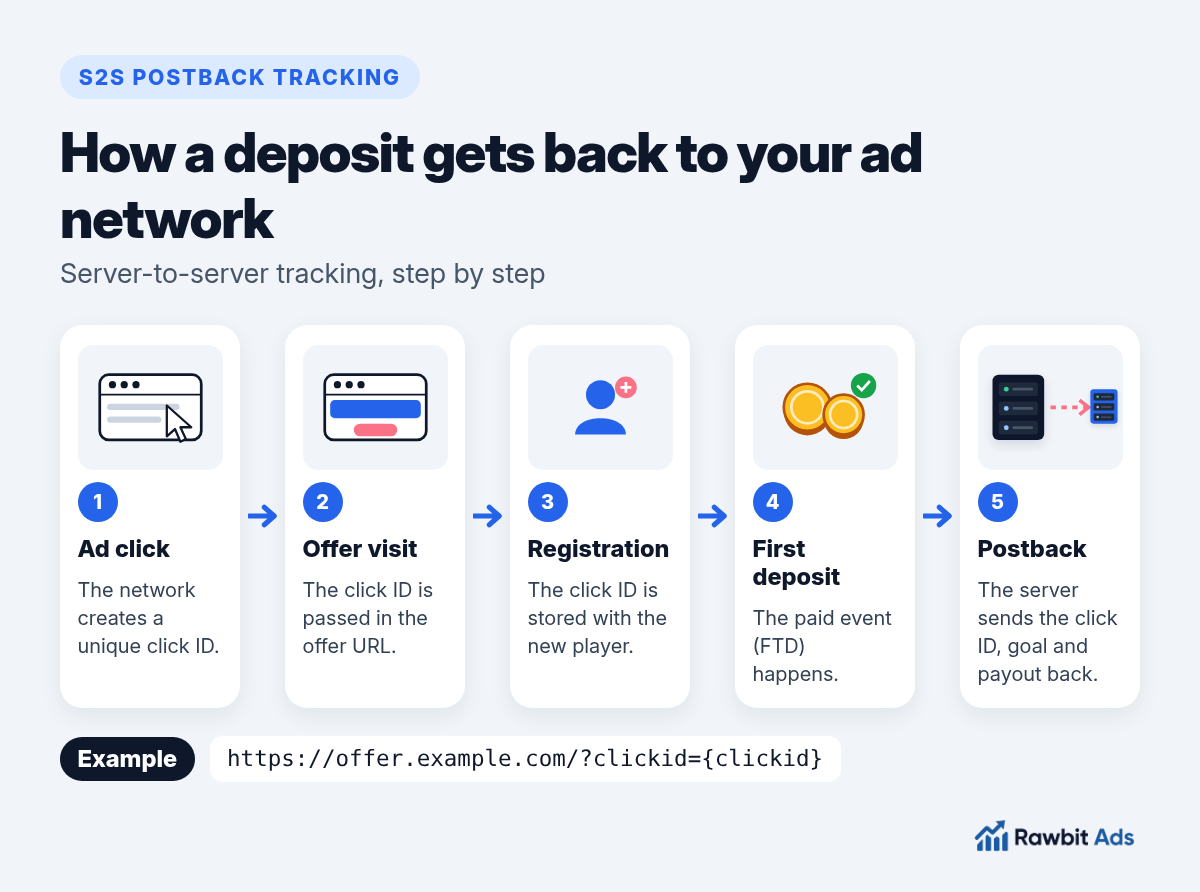
Pass the click ID.
Add the ad network’s click ID macro to your offer or tracker URL, for example https://offer.example.com/?clickid={clickid}. The macro name varies by network.
Store it with the player.
Your tracker or the affiliate program saves the click ID alongside the registration.
Fire a postback on each goal.
When the player registers or deposits, the server calls the network’s postback URL with the same click ID, the goal and, ideally, the payout.
Prevent duplicates.
Atlasbase’s postback guide recommends a unique transaction ID (txid) per conversion so retries aren’t counted twice.
Test before launch.
Send a test click through the full flow and confirm the conversion appears in the network’s stats against the right campaign.
Rawbitads supports postback-based conversion tracking, so you can see which zones bring registrations and deposits and cut the ones that don’t.
💡 Pro tip
Optimize toward the event you’re paid for. Registrations come in faster and help early decisions, but once you have enough FTD data, switch your target CPA and zone decisions to FTDs.
Optimizing iGaming CPA Campaigns
- Cut zones on cost per FTD, not on clicks or registrations alone.
- Watch the registration-to-FTD rate by source. A falling rate often means low-intent placements are creeping in.
- Use target-CPA automation. With Rawbitads SmartBid, you set a target CPA and the system adjusts bids and blacklists underperforming zones in real time.
- Scale within caps. Know the offer’s limits before you raise budgets, and have a second offer ready.
For the creative and campaign side, see how to promote casino affiliate offers with push and pop.
Frequently Asked Questions
What is a CPA offer in iGaming?
An iGaming CPA offer pays the affiliate a fixed amount for each referred player who completes a defined action, most often a first deposit that meets a minimum baseline.
What does FTD mean in iGaming?
FTD means first-time deposit: the first deposit a newly registered player makes. It’s the most common trigger for iGaming CPA payouts and a key metric for media buyers.
Which is better, CPA or RevShare?
It depends on your model. CPA suits media buyers who need to recover ad spend quickly and calculate bids upfront. RevShare suits affiliates with long-term audiences who can wait for revenue over the player’s lifetime. Hybrid deals combine both.
What is S2S postback tracking?
S2S postback tracking is server-to-server conversion reporting. When a player converts, the server sends the original click ID back to the tracker or ad network, so the conversion is attributed without relying on the visitor’s browser.
How do I calculate my maximum bid for a CPA offer?
Start from the payout, subtract your target margin, then multiply by your registration-to-FTD rate and your click-to-registration rate. Replace the estimates with your own tracked data as soon as you have it.
Make Your CPA Offers Measurable
iGaming CPA offers reward media buyers who know their numbers. Read the offer terms, track registrations and FTDs with postbacks, bid from your payout and let deposit data drive every cut and every scale.
📚 Related guides
Buy traffic for your iGaming CPA offers
Track deposits with Rawbitads postbacks, set a target CPA and let SmartBid move budget toward the zones that bring depositing players.
Create your account →