Comparisons⏱️ 8 min readFor affiliates and media buyers
Native ad networks place your ad inside a publisher’s content: in a “recommended for you” widget, in an article feed or between paragraphs. The ad looks like the content around it, with a headline, an image and a small “sponsored” label. For affiliates, that’s useful because native visitors arrive in reading mode, which suits advertorial and review-style pre-landers.
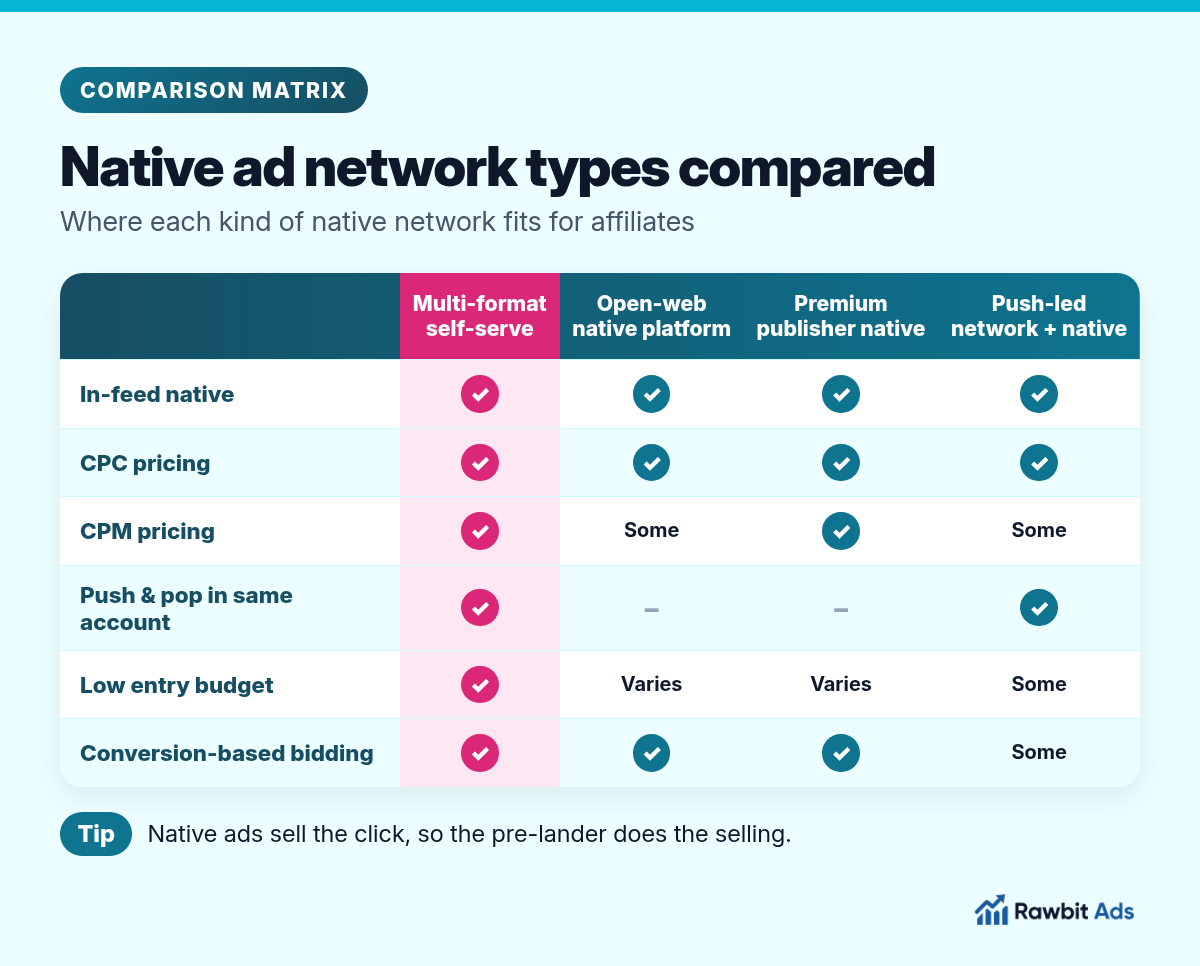
Native networks differ a lot, though. Some are open-web platforms built for performance buyers, some lean on premium publishers, and some are multi-format networks that sell native next to push and pop. This roundup compares well-known native ad networks using details from their own websites, checked on 21 and 22 October 2026. Rawbitads is included, and we’ve tried to be fair about where each one fits.
🔑 Key takeaways
- Native is mostly bought on CPC. Some networks also sell CPM, and several add conversion-based bidding.
- Published entry points vary: $100 minimum deposits, daily budget recommendations or no minimum spend.
- For affiliates, the pre-lander does the selling. The native ad’s job is a curiosity click.
- Check widget or source-level reporting, because cutting weak placements is the main optimization lever.
- A multi-format account lets you move a winning native angle to push, pop or Telegram without starting over.
How Native Ads Work for Affiliates
A native ad usually has three parts: a headline, a thumbnail image and the site or brand name. Visitors click because the headline makes them curious, not because they’re ready to buy. That’s why most affiliate native funnels go ad → advertorial or review pre-lander → offer. The pre-lander tells the story, answers doubts and sends warm visitors to the offer.
If you’re new to the format, our push vs pop vs native guide explains how native compares with other formats, and our guide to picking a self-serve network covers the general checks.
What to Look For in Native Ad Networks
- Pricing models. CPC is standard. CPM and conversion-based bidding are useful once you have tracking in place.
- Entry budget. Look at the minimum deposit and any minimum daily or campaign budget, plus what the network recommends for a real test.
- Placement reporting. You need widget, site or sub-ID data so you can block placements that don’t convert.
- Targeting. GEO, device, OS, browser and, ideally, interest or contextual targeting.
- Creative tools. A/B testing of headlines and images saves time, because native lives or dies on creatives.
- Offer fit. Check each network’s creative and content guidelines before you build a funnel for it.
Native Ad Networks Compared
| Network | Native formats | Pricing | Entry budget | Notable tools |
|---|---|---|---|---|
| Rawbitads | In-feed native: sponsored articles, recommended content, in-feed posts (formats) | CPC and CPM | No minimum spend (advertisers) | SmartBid target CPA with real-time zone blacklisting; push, pop and Telegram in the same account |
| MGID | Native widgets, Smart Widget, In-Content Impact Widget, native video (advertisers) | Prepaid CPC; no CPA model (help center) | $100 minimum deposit, $650 recommended; $50 minimum daily or overall budget limit (campaign setup) | CPA Tune AI bidding, targeting by GEO, OS, browser, traffic source and sub-ID, retargeting |
| Taboola (Realize) | Native placements on publisher sites | CPC or CPM (help center) | No fixed deposit listed; recommended daily budget at least $50 or 10x your CPA goal (budget guide) | Optimized or A/B testing delivery, daily, monthly and lifetime budgets |
| Outbrain | Native placements via Outbrain Amplify (buying options) | Conversion bid strategy toward conversions, CPA or ROAS | Not listed on its advertiser pages | Lookalikes, interest targeting, retargeting, first- and third-party data |
| Revcontent | Native ads on publisher sites (advertisers) | Generally CPC | “No minimum spending requirements” | Real-time reporting, dedicated account management |
| RichAds | Native, plus push, pop, in-page and more | CPC for native (FAQ) | $150 | Target CPA, automated rules |
| Evadav | Native, plus push, pop and in-page (FAQ) | CPC and CPM | $100 | Automated rules for white and blacklists, source-level stats |
Test native traffic on Rawbitads →
A Closer Look at Each Network
Rawbitads. Native placements styled as sponsored articles, recommended content and in-feed posts, on CPC or CPM in 220+ GEOs. SmartBid works from your target CPA and blacklists weak zones in real time, and there’s no minimum spend, so you can test an advertorial angle without a big deposit. The same account also sells push, pop, in-page, direct click and Telegram, which is handy when a native headline starts winning.
MGID. A large open-web native platform with several widget formats. It runs on prepaid CPC and says it doesn’t offer a CPA model, but its CPA Tune tool bids toward a cost per action. The minimum deposit is $100, and MGID recommends $650 so a test collects enough data and unlocks CPA Tune.
Taboola (Realize). Sells on CPC or CPM. Its help center doesn’t list a fixed minimum deposit but recommends a daily budget of at least $50, or ten times your CPA goal, per campaign. Billing can be automatic (typically in $100 increments), monthly invoice or prepaid.
Outbrain. Buys through Outbrain Amplify or programmatically through a DSP. Its buying options page lists a conversion bid strategy that optimizes toward conversions, CPA or ROAS, plus lookalike and interest targeting.
Revcontent. A native platform that says advertisers generally buy on CPC and that there are no minimum spending requirements.
RichAds and Evadav. Push-led networks that also sell native. RichAds prices native on CPC with a $150 minimum. Evadav sells native on CPC or CPM with a $100 minimum.
How a Native Affiliate Funnel Works
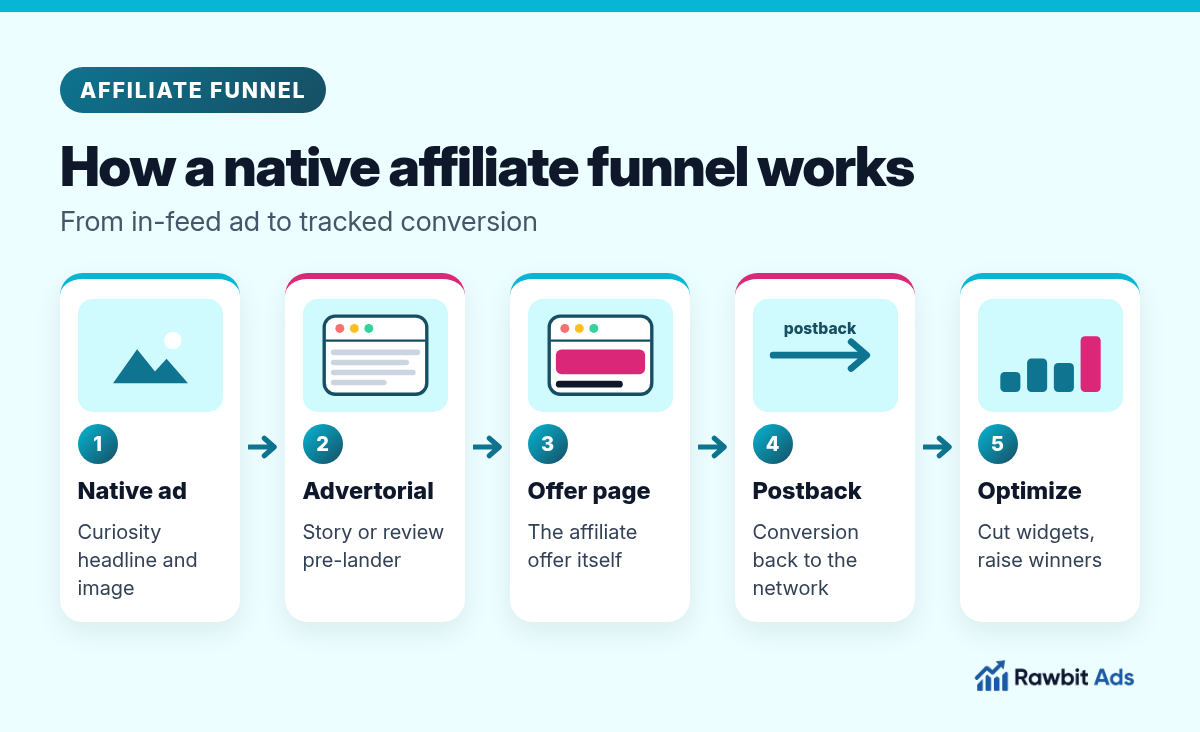
Write the ad for the click.
A curious, specific headline and a natural-looking image. Avoid ad-style banners, because they look out of place in a feed.
Match the pre-lander to the headline.
If the ad promises a story, the page should open with that story.
Send warm visitors to the offer.
One clear call to action near the top and again at the end.
Fire a postback on the conversion.
Pass the click ID and the widget or source ID so the network and your tracker can see which placements convert.
Optimize by placement.
Block sources that spend without converting, and raise bids on the ones that work.
💡 Pro tip
Test headlines before images. On native, a new headline often changes CTR more than a new picture, and it’s faster to make five headlines than five images.
Native Settings That Matter on Every Network
- Separate desktop and mobile. Feeds look different on each, and so do conversion rates.
- Start with three to five ads. Different headlines with the same image, then the reverse.
- Bid near the recommendation. Low CPCs on native often mean you only win low-value placements.
- Use daily caps. Especially in the first week, while placement data builds up.
- Refresh creatives. Native audiences see the same widgets often, so winning ads tire.
- Track to the real goal. For lead or sale offers, optimize to the conversion, not the click. Our bidding models guide explains when to switch to target CPA.
Common Mistakes With Native Networks
- Sending native clicks straight to the offer. Most native visitors need a pre-lander first.
- Clickbait that the pre-lander can’t back up. High CTR with a high bounce rate burns budget.
- Judging a platform on two days. Native needs placement data, so plan a test budget that covers a week or more.
- Ignoring placement reports. Many campaigns are profitable only on a fraction of their sources.
- One creative for every GEO. Headlines and images often need to be localized.
Frequently Asked Questions
What is a native ad network?
It’s an ad network that places ads inside publisher content, such as recommendation widgets and article feeds, styled to match the page. Native ads are usually bought on CPC, and some networks also offer CPM or conversion-based bidding.
Which native ad network is best for affiliates?
It depends on your offer, GEO and budget. Compare networks on pricing models, entry budget, placement reporting and bidding tools, check their creative guidelines, then test two with the same pre-lander and tracking and keep the one with the lower cost per conversion.
How much budget do I need to test native ads?
That depends on the network’s minimum and your CPA. Some networks publish entry points, such as a $100 minimum deposit at MGID or a recommended daily budget of at least $50 at Taboola, while Revcontent and Rawbitads list no minimum spend. Plan enough budget for several conversions per placement group.
Do native ads need a pre-lander?
For most affiliate offers, yes. Native visitors click out of curiosity, so an advertorial or review page that explains the offer usually converts better than sending them straight to it.
Does Rawbitads sell native ads?
Yes. Rawbitads sells in-feed native placements on CPC or CPM in 220+ GEOs, with SmartBid target CPA bidding, real-time zone blacklisting and no minimum spend, alongside push, pop and Telegram in the same account.
Sources
Checked on 21 and 22 October 2026 on each network’s own pages: Rawbitads formats, Rawbitads advertisers, MGID advertisers, MGID pricing and billing, MGID campaign setup, Taboola pricing and billing, Taboola budget and pacing, Outbrain buying options, Revcontent advertisers, RichAds FAQ and Evadav advertiser FAQ.
Test Two, Keep the Winner
The best native ad network for your affiliate offers is the one that accepts your offer type, fits your test budget and gives you the placement data to cut waste. Pick two from this list, run the same advertorial on both and scale the one with the better cost per conversion.
📚 Related guides
Run native ads on Rawbitads
In-feed native placements on CPC or CPM in 220+ GEOs, with SmartBid working toward your target CPA and push, pop and Telegram in the same account. No minimum spend.
Start a native campaign →