
Media Buying⏱️ 8 min readFor beginners, solo affiliates and small teams
Trying a new traffic source usually starts with a question about money: how much do you need to put in before you know whether it’s any good? Many networks ask for a sizeable first deposit. But a small, well-planned test can tell you a lot. This guide shows you how to test a new ad network with $50, step by step: what to set up first, how to split the budget, what to cut and how to judge what you’ve learned.
A quick reality check first. $50 usually won’t prove that a campaign is profitable at scale, especially on offers that pay out only after a deposit or purchase. What it can do is tell you whether the network’s tracking works, whether you can win traffic at your bid, which zones look promising and roughly what a click or a lead costs. That’s enough to decide whether to put in more.
🔑 Key takeaways
- A $50 test is a first read, not final proof. Use it to decide whether to spend more.
- Pick a network where $50 is enough to start. Rawbitads has no minimum spend and no minimum campaign budget.
- Narrow it down: one offer, one GEO, one format.
- Set up tracking and daily caps before you spend a cent.
- Split the budget into phases: broad, cut, narrow, decide.
- Judge the network on a scorecard, not just on whether you made money.
What a $50 Test Can and Can’t Tell You
| A $50 test can tell you | A $50 test usually can’t tell you |
|---|---|
| Whether tracking and postbacks work end to end | Whether the campaign is profitable at scale |
| Whether you win traffic at your bid | The true cost per sale on high-payout offers |
| How fast you can go from sign-up to live traffic | How results change over weeks |
| Which zones send clicks and early conversions | Which creatives win long term |
| Rough cost per click or per lead | How far you can scale before costs rise |
Keep this in mind when you plan, and you won’t judge a network too harshly, or too kindly, on a small sample.
How to Pick a Network for a Small Test
Before you test a new ad network, check that $50 actually gets you in. Look at the minimum deposit, any minimum campaign or daily budget, and whether campaigns pause when your balance gets low. Our ad networks for small budgets comparison lists what many networks ask for.
On Rawbitads there is no minimum deposit and no minimum campaign budget: you can start with whatever amount you’re comfortable testing and scale up as you find what works. You can top up by card, wire or crypto, and campaigns go live as soon as setup and creative review are done. Our guide to picking a self-serve ad network covers the other things to check.
How to Test a New Ad Network With $50
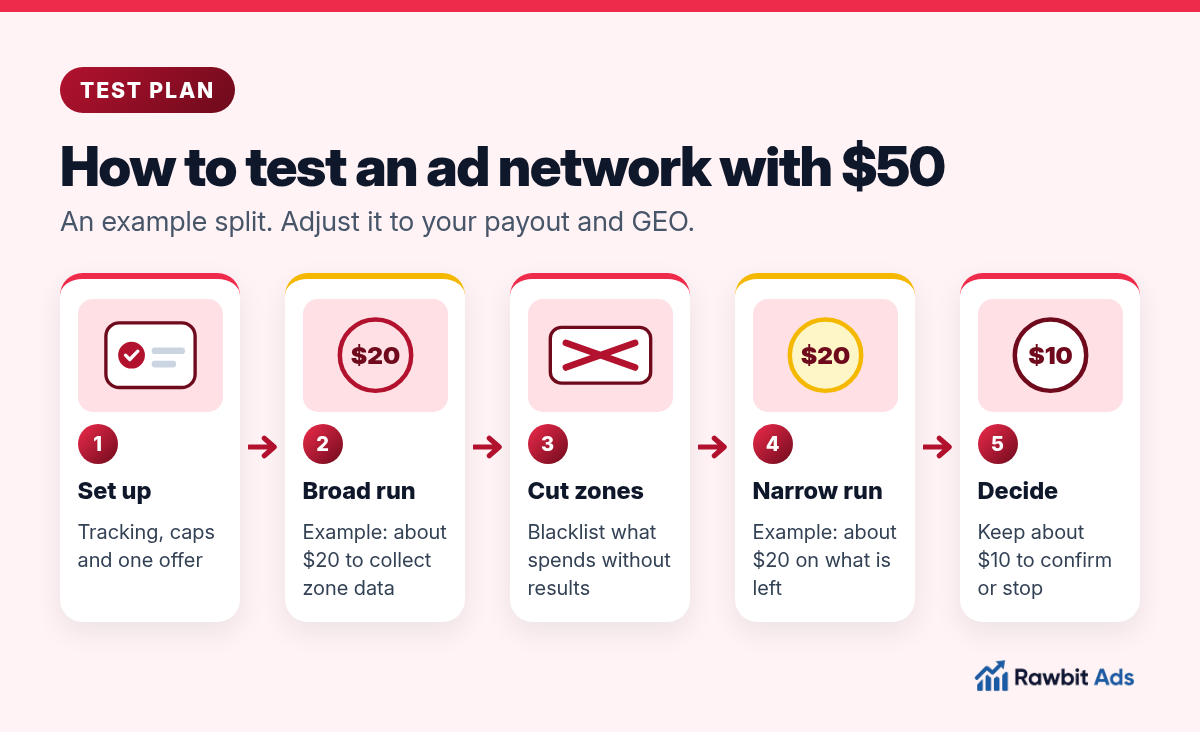
The split below is an example, not a rule. Adjust it to your payout, GEO and format.
Set up before you spend.
Create the campaign, add your postback URL and send a test conversion to make sure it shows up. Set a daily budget cap so a fast zone can’t use the whole $50 in an hour.
Pick one offer, one GEO, one format.
Choose an offer with a payout that’s reachable on a small budget, such as a lead or sign-up rather than a high-ticket sale. Then pick one country and one format your offer suits: pop for simple sign-ups, push for strong hooks, native for story-led offers.
Broad run (example: about $20).
Start at or near the network’s minimum or recommended bid for your GEO and let the traffic run across zones. You’re collecting data on where clicks and early conversions come from.
Cut weak zones.
Blacklist zones that spent without a single conversion or meaningful action. Keep the ones that converted or came close.
Narrow run (example: about $20).
Run the remaining budget on the zones you kept. If you get conversions, this is where SmartBid can help: set a target CPA and it adjusts bids and blacklists underperforming zones in real time.
Decide (example: about $10 in reserve).
Use the last part to confirm a promising result or to try one change, such as a new creative or pre-lander. Then make the call: scale, adjust or stop.
💡 Pro tip
If your offer pays only after a deposit or purchase, track an earlier step too, such as a registration or lead. On a small budget you may see several of those before your first paid conversion, and they tell you whether the traffic is worth more spend.
Setup Checklist Before You Launch
- Tracking: postback set and tested, click ID and zone parameters passed through.
- Caps: daily budget cap on; frequency cap if the format supports it.
- Targeting: one GEO, device type that suits the offer. Rawbitads also lets you add OS, browser, carrier, connection type, language and time of day.
- Bidding model: CPC is the safer start for push and native; CPM is standard for pop. Our bidding models guide explains the difference.
- Creative: two or three variations, so one bad creative doesn’t sink the test.
- Landing page: fast on mobile. A simple pre-lander helps on push and pop; see our pre-landers guide.
Start a $50 test with no minimum spend →
How to Judge the Results
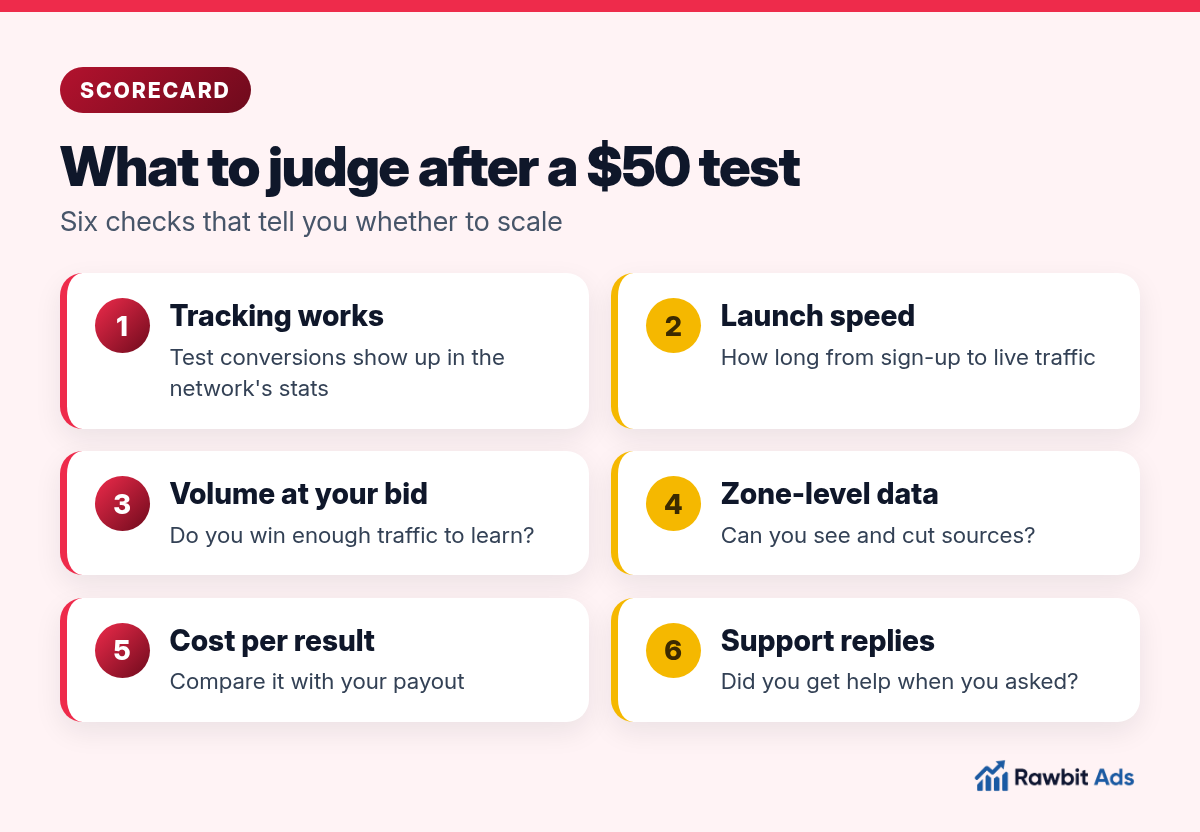
Profit is the end goal, but on $50 it’s not the only thing worth measuring. Score the network on these six checks:
- Tracking works. Did test and real conversions show up in the network’s stats and your tracker?
- Launch speed. How long did it take from sign-up to live traffic?
- Volume at your bid. Did you win enough traffic to learn something, without raising the bid far above the recommendation?
- Zone-level data. Could you see which sources sent traffic and cut the weak ones?
- Cost per result. How did your cost per lead or conversion compare with your payout?
- Support. If you asked a question, did you get a useful answer?
If a network scores well on most of these and your cost per result is close to your payout, it’s worth a bigger test. If tracking didn’t work or you couldn’t cut zones, look elsewhere before spending more.
Common Mistakes on a $50 Test
- Testing too many things. Three GEOs and two formats on $50 means none of them gets enough data.
- No daily cap. A single fast zone can use your whole budget before you check.
- Bidding far below the recommendation. You win little traffic, or only the weakest zones.
- No postback. Without conversion data you can’t cut zones, and cutting zones is how small budgets survive.
- Judging too early. Give the campaign enough time and traffic before you make the call.
- Spreading $50 across many networks. Two networks tested properly beat five tested badly. Our ad network alternatives guide can help you choose which to try.
Frequently Asked Questions
Can you really test an ad network with $50?
Yes, as a first read. $50 is usually enough to check tracking, launch speed, whether you win traffic at your bid, which zones look promising and roughly what a click or lead costs. It’s rarely enough to prove profitability at scale, so use it to decide whether to spend more.
How should I split a $50 test budget?
One example is about $20 for a broad run to collect zone data, then cutting weak zones, about $20 on the zones you kept, and about $10 in reserve to confirm a result or try one change. Adjust the split to your payout, GEO and format.
Which ad format is best for a small test?
Pick the format that suits your offer. Pop is simple to launch and often used for sign-up offers, push works for offers with a strong hook, and native suits story-led offers. Test one format at a time on a small budget.
What should I track during an ad network test?
Track conversions with a postback, plus an earlier step such as a registration or lead if your offer pays only after a deposit or purchase. Pass the click ID and zone parameters through so you can see which sources convert.
Does Rawbitads have a minimum deposit for testing?
No. Rawbitads has no minimum spend, no minimum deposit and no minimum campaign budget, so you can start with whatever amount you’re comfortable testing, top up by card, wire or crypto and scale up as you find what works.
Sources
Checked on 22 October 2026: Rawbitads advertisers and advertiser FAQ, Rawbitads formats and the Rawbitads homepage. The budget split is an illustrative example, not a benchmark.
Small Budget, Clear Answer
A $50 test won’t make you rich, but it can save you from a bad deposit, or point you to a network worth scaling. Set up tracking first, keep the test narrow, cut fast and judge the network on a clear scorecard.
📚 Related guides
Run your $50 test on Rawbitads
No minimum spend and no minimum campaign budget: top up what you want to test, launch push, pop, native, Telegram or calendar ads in 220+ GEOs and track every conversion.
Start your test →