Comparisons⏱️ 9 min readFor media buyers and affiliates
A self-serve ad network lets you buy traffic on your own: you sign up, add funds, build a campaign, set bids and targeting, and optimize from a dashboard without waiting for an account manager. Most performance networks work this way now, so the real question isn’t whether to go self-serve. It’s which network fits your offers, your budget and the way you like to work.
This guide shows you how to compare self-serve networks on things you can check before you deposit: ad formats, minimum deposits, pricing models, targeting and optimization tools. We use four well-known platforms as worked examples, including our own, Rawbitads. All competitor details come from each network’s own pages, checked on 21 October 2026. Networks change their terms often, so check again before you pay.
🔑 Key takeaways
- Start with formats: a network is only useful if it sells the formats your offer needs, such as push, pop, native, Telegram or direct click.
- Compare minimum deposits and minimum budgets separately. The deposit is what you pay to start, and campaign budget rules decide how far it goes.
- Check which pricing models each format supports. CPC, CPM and CPA aren’t available on every format.
- Look for automated bidding toward a target CPA and zone blacklisting, because they save the most time once tests are live.
- Run the same offer, funnel and tracking on two networks before you decide.
What a Self-Serve Ad Network Gives You
A self-serve platform hands you the controls. You choose GEOs, devices and bids, upload creatives, connect a tracker and react to the data yourself. In return you get speed: you can launch a test the same day, cut losing placements in minutes and scale winners without waiting for anyone.
Self-serve doesn’t mean you’re alone. Many networks still offer support, account managers at higher spend levels, or ready-made whitelists. But the core work happens in your dashboard, so the quality of that dashboard and its tools matters as much as the traffic.
The Five Things to Compare Before You Deposit
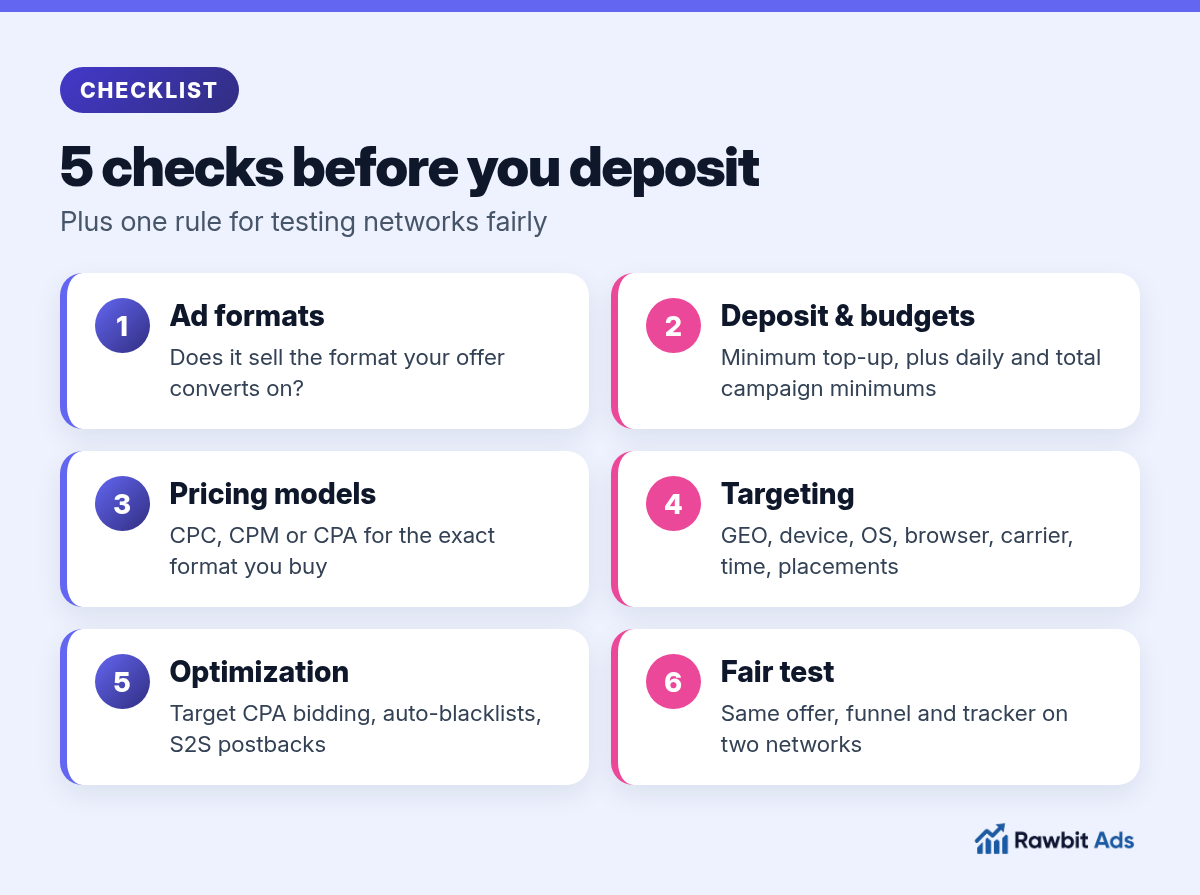
- Ad formats. Does the network sell the formats your offer converts on? See our push vs pop vs native guide if you’re not sure which you need.
- Minimum deposit and budgets. What’s the smallest top-up, and are there minimum daily or total campaign budgets?
- Pricing models. Which of CPC, CPM and CPA are available for the format you want? Our CPC vs CPM vs CPA guide explains when each one fits.
- Targeting. Can you split by GEO, device, OS, browser, carrier, time of day and placement?
- Optimization tools. Is there automated bidding toward a target CPA, rule-based blacklisting and S2S postback support?
Self-Serve Ad Networks Compared
Here’s how four popular self-serve platforms compare on formats, minimum deposits and pricing, based on their own websites and help centers.
| Network | Ad formats for advertisers | Minimum deposit | Pricing models |
|---|---|---|---|
| Rawbitads | Push, in-page push, popunder, direct click, native, Telegram channel ads, Telegram Mini App ads, calendar ads | No minimum spend, per its advertiser page | CPC and CPM on most formats; CPM and CPA on pop; CPC on direct click; CPM on Telegram (formats page) |
| PropellerAds | Push, in-page push, popunder (onclick), Telegram Mini App ads, interactive ads, paid social (homepage) | From $100, depending on payment method (terms) | CPM, SmartCPM, CPC, SmartCPC and CPA Goal, depending on format (help center) |
| Adsterra | Popunder, Social Bar, in-page push, interstitials (advertisers page) | Depends on payment method; its FAQ gives $100 for Paxum. CPM and CPC campaigns need at least $25 total and daily budget | Popunder: CPM, CPA. Social Bar and in-page push: CPM, CPC, CPA. Interstitial: CPM, CPA |
| RichAds | Push, popunder, in-page, direct click, display, native, Telegram Mini App ads (homepage) | $150 (FAQ) | CPC for push, iOS in-page and native; CPM for popunder, redirect and display; both for Telegram Mini Apps |
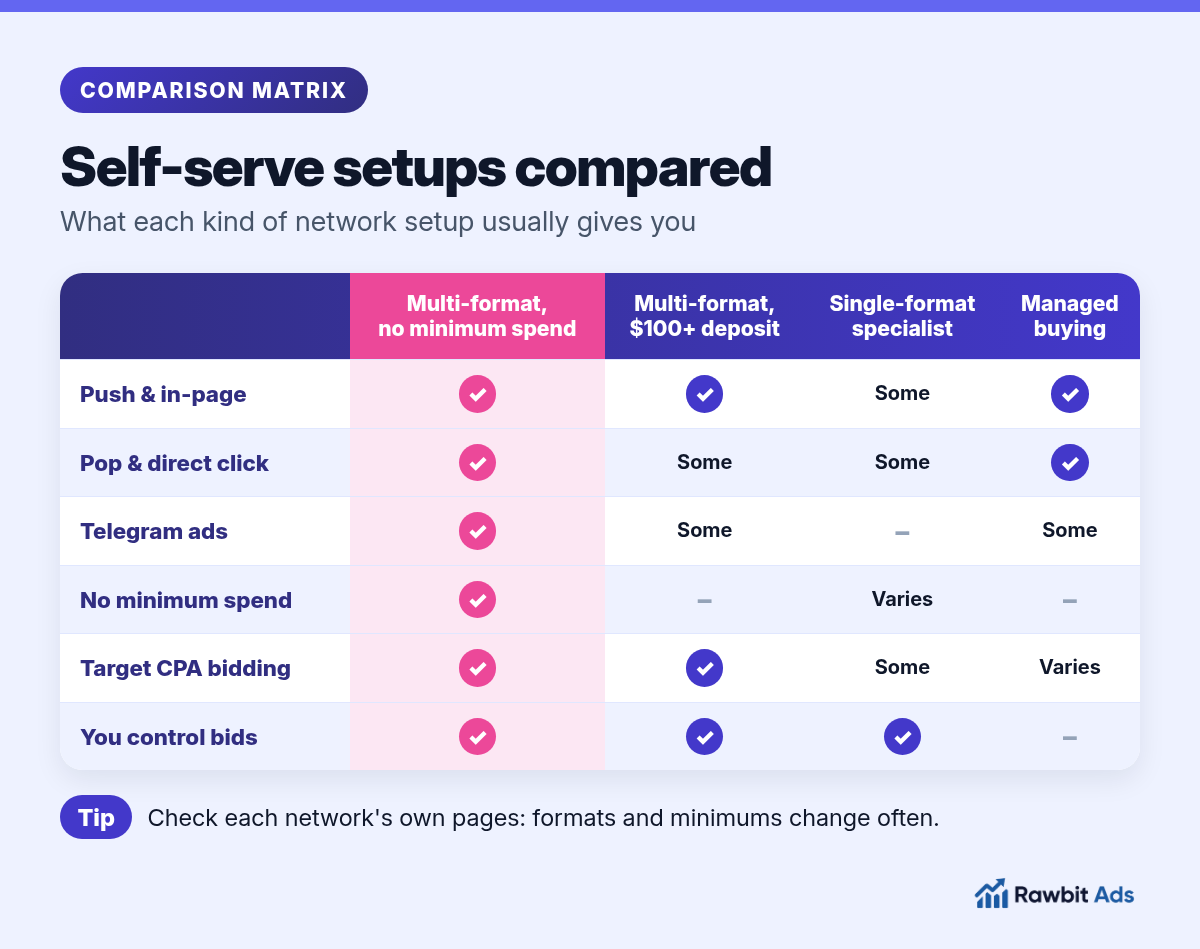
A few things stand out. Telegram Mini App ads are now offered by three of the four. Direct click traffic is listed by Rawbitads and RichAds. Calendar ads are only listed by Rawbitads. And pricing differs by format on every platform, so always check the model for the exact format you plan to buy.
Launch a test campaign on Rawbitads →
How Targeting Compares
All four networks cover the basics: country, device type, operating system and browser. The differences are in the extra layers.
| Network | Targeting listed on its own pages |
|---|---|
| Rawbitads | GEO, device, OS, browser, carrier and time of day; Telegram by channel topic, language and audience size |
| PropellerAds | GEO with cities or states, platform, OS and version, browser and language, connection type, VPN, carrier and ISP, zones and subzones, day parting, frequency capping, user activity, audiences and retargeting (help article) |
| Adsterra | “20+ targeting settings”, plus a traffic estimator for bids and volumes |
| RichAds | 17 targeting options, including device model and OS, user activity, connection type, carrier and IP address |
More options aren’t automatically better. What matters is whether you can split the segments that change your results. For most offers that means GEO, device, OS, carrier and time of day, plus the ability to block or allow individual placements.
How Optimization Tools Compare
Once a test is running, the tools that save the most time are automated bidding toward a cost per conversion and automatic blacklisting of placements that spend without converting.
- Rawbitads: SmartBid lets you set a target CPA. It adjusts bids and blacklists underperforming zones in real time, so budget moves toward the placements that convert.
- PropellerAds: CPA Goal 2.0 adjusts bids toward your KPI, plus a Traffic Estimator, a Win Rate dashboard and NIKO, an AI assistant that helps set up campaigns.
- Adsterra: Smart CPM, CPA Goal rules and a traffic estimator, with S2S postback support and ready integrations with common trackers.
- RichAds: Target CPA, automated rules, micro bidding by parameter and Performance Mode, which adds a fresh whitelist of sources.
All four support conversion tracking with a tracker or postback, which you need before any of these tools can work. If you haven’t set that up yet, our iGaming CPA guide walks through S2S postbacks step by step.
Where Rawbitads Stands Out
We built Rawbitads for buyers who want many formats in one place without a high entry ticket. Compared with the networks above, three things are different:
- No minimum spend. Our advertiser page says no minimum spend and no contracts, so you can start with a small test.
- Formats you don’t find everywhere. Alongside push, pop, in-page and native, you can buy direct click traffic, Telegram channel ads, Telegram Mini App ads and calendar ads from one account.
- SmartBid on a target CPA. Set the cost per conversion you can afford, and SmartBid adjusts bids and cuts weak zones for you.
To be fair, the other networks have strengths too. PropellerAds offers interactive and paid social formats, Adsterra has its Social Bar and interstitial formats, and RichAds lists pre-roll video. If your plan depends on one of those formats, test where it’s sold.
How to Test Two Networks Fairly
Pick one offer and one funnel.
Use the same pre-lander, offer and payout on both networks so the network is the only thing that changes.
Match the targeting.
Same GEO, device, OS and schedule, with similar bids for the format.
Connect the same tracker.
Use S2S postbacks on both, with the zone or placement ID passed in the URL.
Set equal test budgets.
Give each network enough spend to reach a handful of conversions, not just clicks.
Compare cost per conversion.
Judge on CPA or ROI, not on CTR or click price.
Scale the winner, keep the runner-up.
A second network gives you more volume when the first one gets saturated.
💡 Pro tip
Write your cut rules before you launch, for example “pause any zone that spends 2x the target CPA without a conversion”. It stops you judging one network more harshly than the other.
Common Mistakes When Choosing a Network
- Choosing on impression volume alone. Big totals don’t tell you how much traffic exists for your GEO, format and device.
- Comparing different funnels. If the pre-lander or offer changes, you’re testing the funnel, not the network.
- Ignoring budget rules. A low deposit can still come with daily or total campaign minimums.
- Skipping tracking. Without postbacks, you can’t use target CPA bidding or compare networks fairly.
- Giving up after one day. Auto-bidding tools need conversions to learn. Plan a test that runs long enough to collect them.
Frequently Asked Questions
What is a self-serve ad network?
It’s an ad network where advertisers create, fund and manage campaigns themselves from a dashboard: choosing formats, targeting, bids and creatives, and optimizing with live statistics, without needing an account manager.
What minimum deposit do self-serve ad networks ask for?
It varies by network and often by payment method. Among the networks in this guide, published minimums ranged from $100 to $150 in October 2026, and Rawbitads lists no minimum spend. Also check minimum daily or total campaign budgets.
Which pricing model should I choose on a self-serve network?
It depends on the format and your data. CPC suits push and native when you want to pay for clicks, CPM suits pop and Telegram, and CPA or target CPA bidding works best once your tracking sends conversions back to the network.
How many ad networks should I test?
Most buyers test two at a time with the same offer, funnel and tracking. That’s enough to compare cost per conversion without spreading the budget too thin.
Is Rawbitads a self-serve ad network?
Yes. Rawbitads is a self-serve platform with push, in-page, pop, native, Telegram (channel and Mini App ads), direct click and calendar ads across 220+ GEOs, SmartBid target CPA bidding and no minimum spend.
Sources
Competitor details were checked on 21 October 2026 on each network’s own pages: Rawbitads advertisers, Rawbitads formats, PropellerAds homepage, PropellerAds terms, PropellerAds pricing models, PropellerAds targeting, Adsterra advertisers, RichAds homepage and RichAds FAQ.
Pick the Network That Fits Your Funnel
The best self-serve ad network is the one that sells your format, fits your budget and gives you the tools to cut waste fast. Compare the five points above, test two networks on the same funnel and let cost per conversion decide.
📚 Related guides
Try a self-serve network with no minimum spend
Push, in-page, pop, native, Telegram, direct click and calendar ads in 220+ GEOs, with SmartBid working toward your target CPA. Launch in under 10 minutes.
Create your Rawbitads account →