Ad Formats⏱️ 7 min readFor advertisers and media buyers
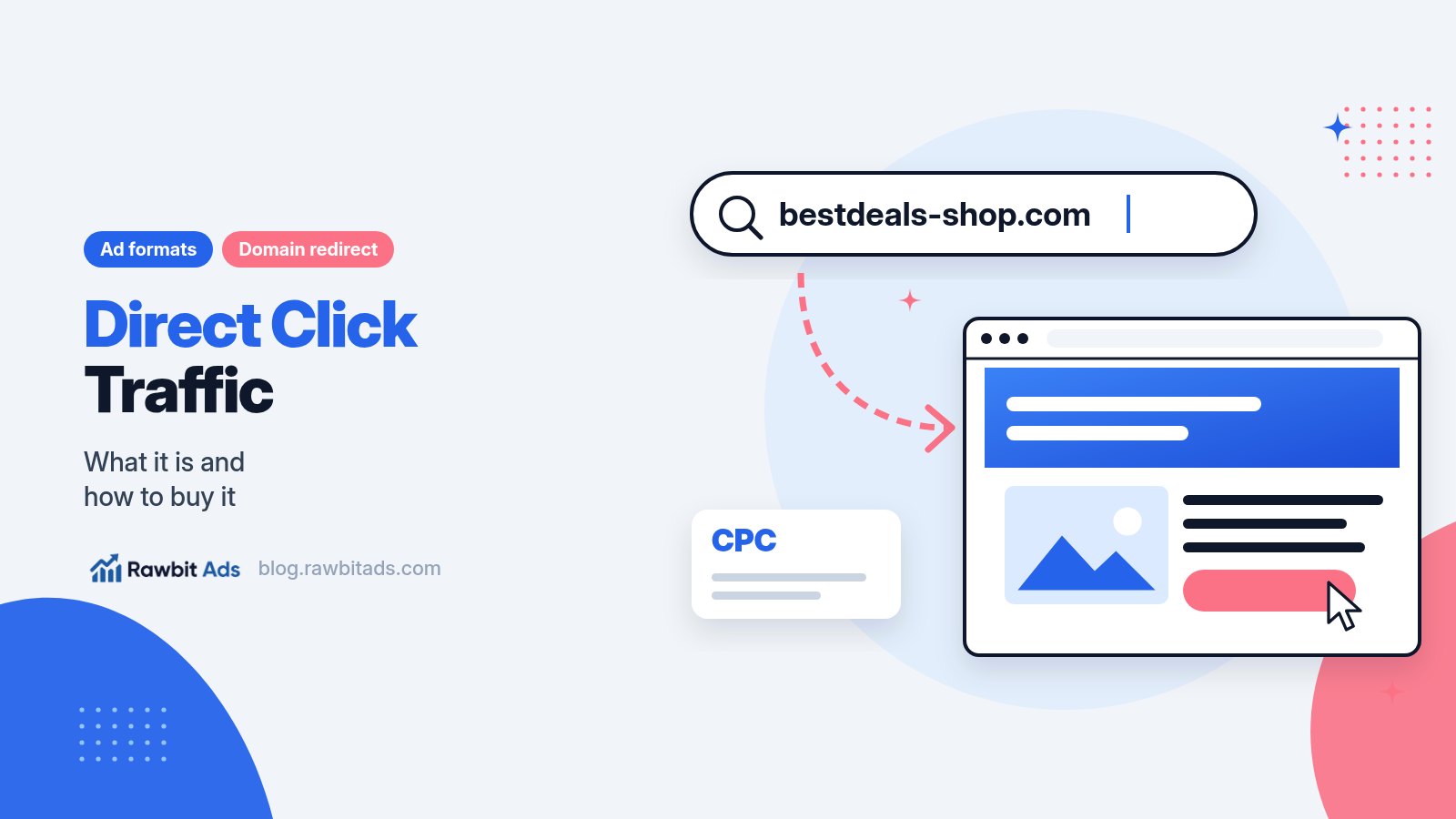
Direct click traffic is one of the least talked-about formats in performance marketing, and that’s part of its appeal. There’s no banner, no notification and no creative to design. A visitor arrives at a domain, and instead of seeing a page of links, they’re sent straight to your landing page. If your offer matches what they were looking for, that’s about as short as a funnel gets.
This guide explains what direct click traffic is, how domain redirect advertising works, which offers suit it, and how to launch, target and optimize a direct click campaign.
🔑 Key takeaways
- Direct click traffic (also called domain redirect or zero-click traffic) comes from parked, expired or mistyped domains that redirect visitors straight to an advertiser’s page.
- There’s no ad creative: your landing page is the first thing the visitor sees, so it has to do all the selling.
- Targeting is about matching the domain’s intent through keywords or categories, then filtering by device, OS and time.
- It’s usually bought on CPC, and it works best for offers with broad, everyday intent, such as eCommerce, finance, travel and utilities.
What Is Direct Click Traffic?
Direct click traffic is traffic sent from a domain straight to an advertiser’s landing page, without the visitor clicking an ad first. The “click” is the visitor’s own action: typing a domain into the browser or following an old link.
Most of it comes from parked domains, which are domains that are registered but not used for a website. Wikipedia’s article on domain parking explains that owners can monetize the type-in traffic these domains receive, and that the domain name itself gives “clues as to the intent of the visitor”. Expired domains that once hosted websites are also used, because they keep many of their old inbound links.
You’ll see this format sold under several names:
- Direct click or domain redirect traffic
- Zero-click traffic, because there’s no ad to click
- Parked domain or type-in traffic
On Rawbitads, direct click ads are described as domain redirect traffic from parked domains, where users who mistype a URL or visit a parked domain are redirected to your offer.
How Domain Redirect Advertising Works
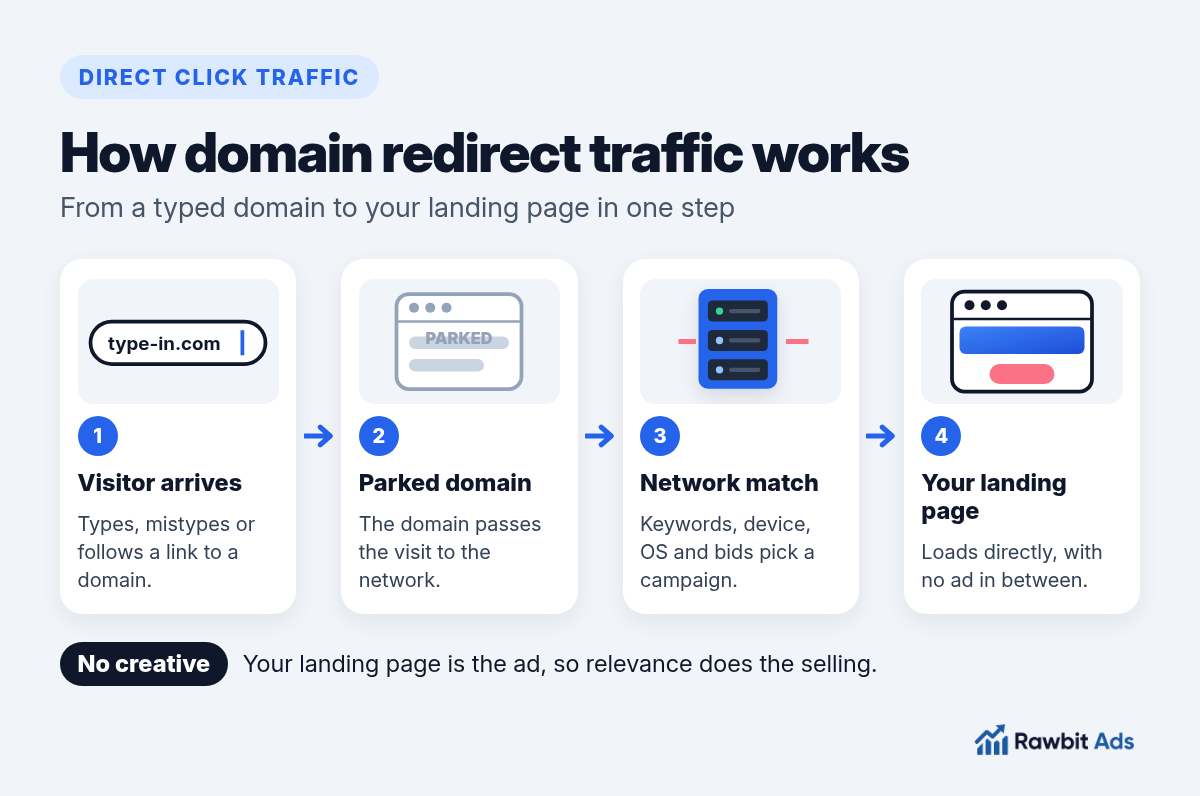
- A visitor arrives at a domain. They typed it, mistyped a similar one or followed an old link.
- The domain sends the visit to an ad network. The parked domain is set up to monetize its traffic through the network.
- The network matches the visit to a campaign. It looks at the domain’s keywords or category, the visitor’s device, OS and location, and the bids of eligible campaigns.
- The visitor lands on your page. The winning advertiser’s landing page loads directly, with no ad in between.
Because there’s no creative, the match between domain and offer does the job a banner or push title would normally do.
Direct Click vs Pop vs Push
Direct click looks a bit like pop, since both deliver a full landing page. The difference is the moment and the intent.
| Format | How the user arrives | Creative needed | Typical pricing |
|---|---|---|---|
| Direct click | Typed or followed a link to a domain, then redirected | No, the landing page is the ad | CPC |
| Pop | Clicked on a publisher site; your page opens in a background tab | No, the landing page is the ad | CPM, CPA |
| Push | Clicked a notification | Yes: title, text, icon and image | CPC, CPM |
Pop reaches people while they’re doing something else, so your page has to interrupt and convince. Direct click reaches people who were trying to go somewhere, so your page has to show them they’ve found something relevant. Our popunder traffic guide covers the pop side, and push vs pop vs native ads compares the main formats.
Which Offers Fit Direct Click Traffic?
The best offers match the kind of intent domains carry: people looking for a product, a service or a type of site.
- eCommerce and retail: deals, marketplaces and product categories that match shopping keywords.
- Finance: comparison sites, apps and lead-generation offers.
- Travel: bookings, deals and travel tools.
- Utilities and software: VPNs, cleaners, browser extensions and other tools.
- Local services and lead generation: offers where a quick form fill is the conversion.
iGaming buyers can also test direct click once their core push and pop funnels convert. Our iGaming traffic sources guide explains where it fits in the mix.
Landing Pages for Direct Click Traffic
Your landing page is your only creative, so build it for a visitor who didn’t expect to see it.
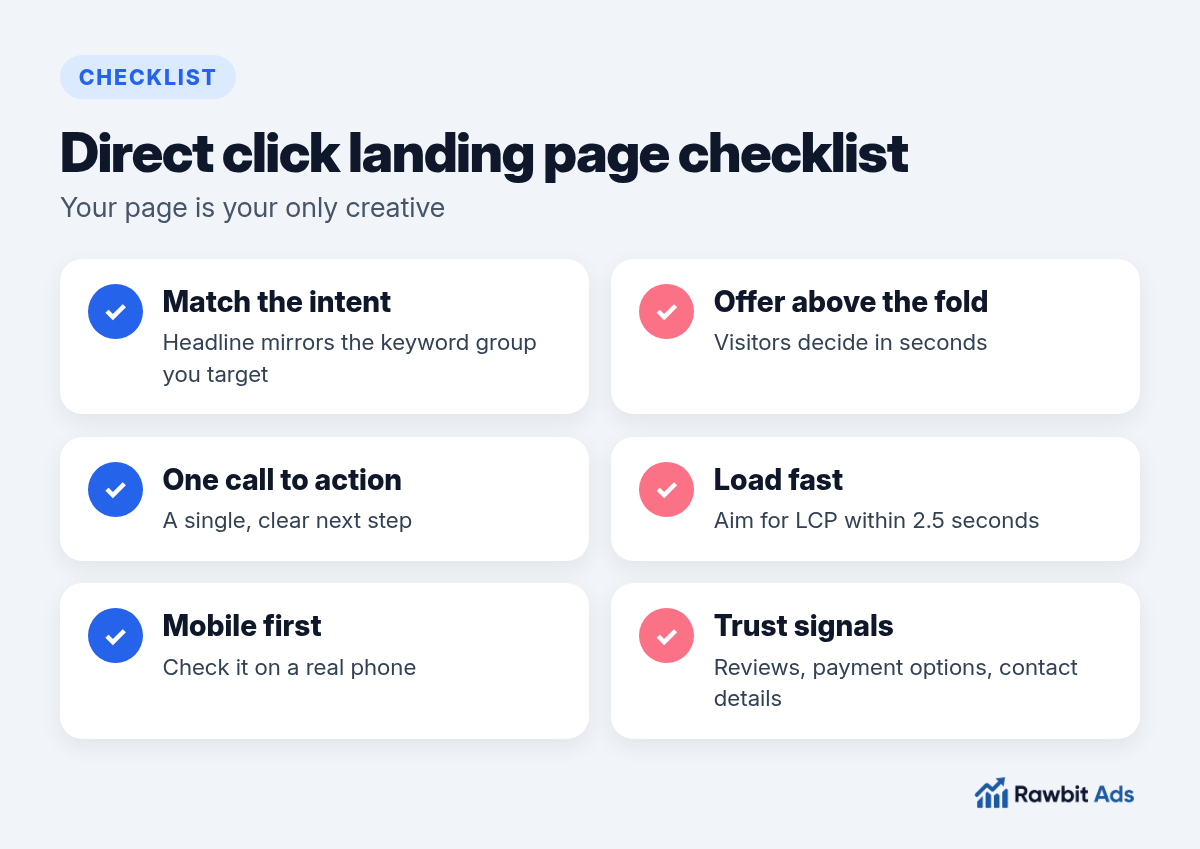
- Match the intent in the headline. If you target travel keywords, the first line should be about travel.
- Show the offer above the fold. Visitors decide in seconds whether to stay.
- Use one call to action. A single, clear next step beats a page full of options.
- Load fast. Google’s Web Vitals guidance suggests Largest Contentful Paint within 2.5 seconds. Every second of loading is a second the visitor might leave.
- Design for mobile first. Check the page on a real phone before you launch.
- Add trust signals. Reviews, recognizable payment options or clear contact details help a cold visitor feel safe.
💡 Pro tip
Build a separate landing page variant for each keyword group you target. A travel visitor and a finance visitor need different headlines, even if the offer behind them is the same.
How to Launch a Direct Click Campaign
Define the conversion and tracking.
Set up S2S postback tracking so the network can see which domains and keywords convert.
Choose keywords or categories.
Pick the ones that clearly match your offer. Start narrow and relevant rather than broad.
Set your filters.
Target by device, OS, browser and time of day, and split mobile from desktop.
Set a CPC bid.
Work back from your payout and conversion rate to a break-even CPC. Our CPC vs CPM vs CPA guide shows the formula.
Launch with a test budget.
Give each keyword group enough clicks to show a pattern before you judge it.
Review by domain and keyword.
Keep what converts, blacklist what doesn’t.
Scale gradually.
Add related keywords or raise bids on proven segments one step at a time.
Optimizing Direct Click Traffic
- Optimize at domain and keyword level. Direct click volume is spread across many sources, and a few usually do most of the converting. Find them and concentrate there.
- Use whitelists for proven sources. Once you know which domains or keywords convert, run them in a separate campaign with its own bid.
- Watch bounce and time on page. If visitors leave instantly, the keyword match or the headline is probably off.
- Test landing pages before bids. With no creative to tweak, the landing page is your biggest lever.
- Let automation help. On Rawbitads, SmartBid adjusts bids and blacklists weak zones in real time toward your target CPA once conversions are flowing.
Frequently Asked Questions
What is direct click traffic?
Direct click traffic is traffic redirected from parked, expired or mistyped domains straight to an advertiser’s landing page, without an ad or banner in between. It’s also called domain redirect or zero-click traffic.
Is direct click traffic the same as pop traffic?
No. Both deliver a full landing page without a creative, but pop opens your page in a background tab after a click on a publisher site, while direct click redirects a visitor who arrived at a domain straight to your page.
Which offers work best with direct click traffic?
Offers with broad, everyday intent tend to fit best, such as eCommerce, finance, travel, utilities and lead generation. Match your keywords or categories to the offer so the visitor finds something related to what they were looking for.
How is direct click traffic priced?
It’s usually sold on a CPC basis, where you pay for each visitor redirected to your page. On Rawbitads, direct click is available on CPC.
How do I optimize a direct click campaign?
Track conversions with S2S postbacks, review results by domain and keyword, blacklist sources that don’t convert, move proven sources into a whitelist campaign and keep testing landing pages, since the page is your only creative.
Start Testing Direct Click Traffic
Direct click is a simple format with one big lever: relevance. Choose keywords that match your offer, build a landing page that confirms the visitor is in the right place, track every conversion and let domain-level data show you where to scale.
📚 Related guides
Buy direct click traffic on Rawbitads
Domain redirect traffic on CPC, with deep targeting and SmartBid optimization, in the same self-serve account as your other formats.
Launch a direct click campaign →